

Sterling Macer Jr.’s “Liz Here Now” finds its beating heart not in tragedy, but in an unexpected salvation: a housekeeper’s fierce, protective love for two children who have no one else. Based on Todd Connor’s autobiography, the film centers on Liz—a woman who steps into the void left by absent or broken parental bonds, becoming the anchor that keeps two lives from drowning. What could have been a conventional period-piece survival story instead becomes something far more urgent: a portrait of how connection, loyalty, and everyday acts of care can reshape a life. Macer refuses to sentimentalize poverty or hardship; instead, he keeps the focus on the relationship itself—the dynamic between protector and protected, the unspoken language of trust built through consistency. The film’s power lies in its contemporary relevance. In a society fracturing under isolation and institutional failure, Liz Here Now asks: What if the person who saves you isn’t a family member, but someone who chooses to show up? The answer, as told here, is transformative—and entirely believable.
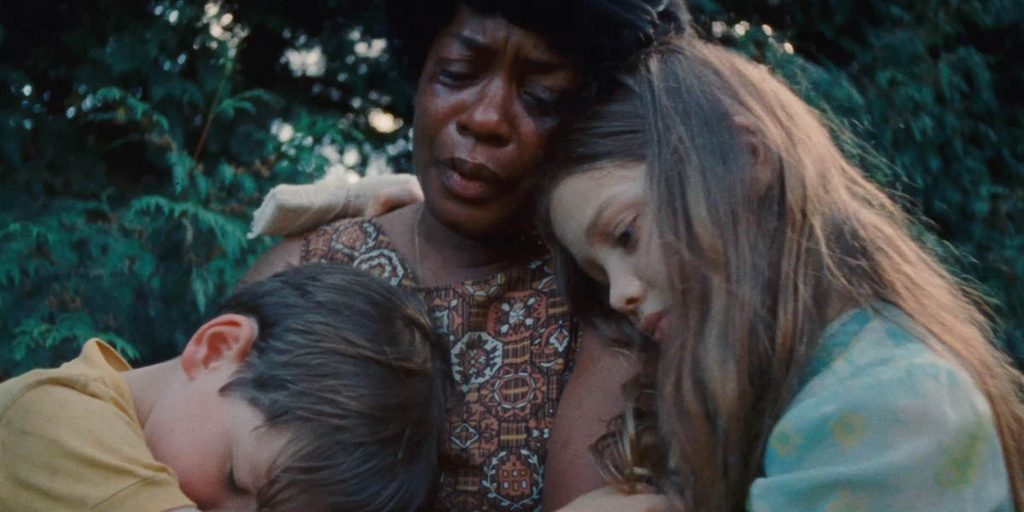
Set in 1960s Oakland, Liz Here Now transforms what could have been a distant historical tragedy into an act of defiance. Aujanue Ellis-Taylor’s Liz is a housekeeper who sees what others ignore: Todd’s bruises, his mother Jane’s (Rachelle Lefèvre) cold indifference, the machinery of abuse operating behind closed doors. But Liz refuses the role of silent witness. She confronts Jane directly, then her husband—a choice that costs her everything. Fired immediately and later arrested for her intervention, Liz faces the full weight of institutional indifference: a system designed to protect abusers, not children. Yet even jail time and a stern court warning cannot sever her commitment. With unlikely help from the detective who investigated her case, Liz maneuvers her way back into the household, her presence a quiet rebellion against a system that has already deemed her expendable. The film’s power emerges here—not in Liz’s heroism, but in the cost of her heroism. Her son’s affiliation with the Black Panthers adds another layer: protection becomes political, care becomes resistance, and a housekeeper’s loyalty becomes an act of social defiance in a city burning with systemic injustice.
What emerges from Liz Here Now is not a story of victimhood, but of agency—a woman who chooses her children and refuses to be erased by a system determined to silence her. Aujanue Ellis-Taylor gives us a Liz who is neither saint nor savior, but something far more human: a woman operating from a mother’s love, even when those children are not her own. Her son may question the cost of her devotion, the Black Panthers may demand her freedom in the courthouse, but Liz’s quiet persistence—her ability to claw her way back into that household despite every institutional barrier—becomes the film’s deepest statement. She doesn’t win through grandeur or legal victory. She wins through sheer tenacity, through showing up, through refusing to let the system’s indifference become her own. Because of Liz’s intervention, a young boy survived childhood abuse. Because of her love, he lived long enough to grow up, to process his trauma, to transform it into story. Liz Here Now is that story—a portrait of how one woman’s refusal to stay quiet became the foundation for another’s survival. It’s a film that will have you pulling for Liz from the opening frame, and cheering her fight long after the credits roll.
I rate this film (3.5/4) 🍿
Magazine Muzic Keeping it 💯with Director Sterling Macer, Jr.

Expressing my opinion
Chief Editor